
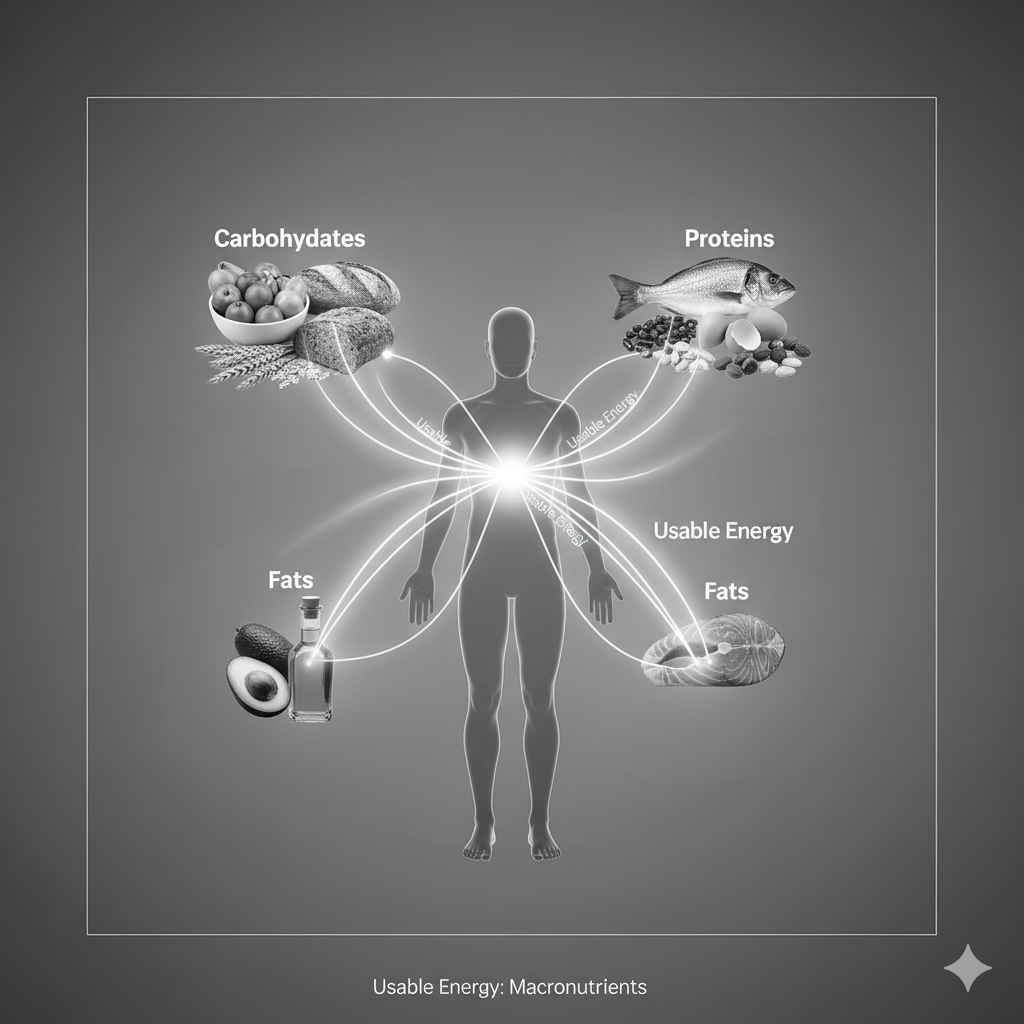
What is Usable Energy? Macronutrients
(No, A ‘Macro’ isn’t short for Macaroni and Cheese!)
Food can be placed into three categories: carbohydrates, proteins, and fats. Your body needs all three to create fuel that it can use for its most important functions.
What are Carbs?
Carbohydrates are a broad category of macronutrients that include sugar, starches and fibre. They serve as the primary energy source for the body. They can be classified as simple carbs ( these include sugars) or complex carbs ( these include starches and fiber).
Sugars are a type of simple carbs that can be naturally occurring ( found in fruit and milk) or added ( like white sugar ). In essence, all sugars are carbohydrates, but not all carbohydrates are sugars.
Why is your body hungry for carbs?
Carbs are great fuel when you need them for quick energy or short term use. They are simplest to break down and digest quicker than proteins or fats. Carbs break down into glucose, which travels through the body in blood, supplying energy to tissues and cells.
Balancing Sugars
The body seeks balance when it comes to glucose; too much or too little prevents it from functioning properly. Foods made primarily of sugar and white starches – say, a honey-glazed doughnut – digest very quickly. This sends a flood of glucose into your bloodstream all at once. Your blood sugars spike to a level your body finds uncomfortable. It sounds the alarm and hormones such as insulin rush in to clear the excess. Now your body is uncomfortable because blood sugar levels are too low. You “crash”, or lay on the couch in a “food coma”, too exhausted to do anything.
To make a long story short, sugary carbs give you a quick bursts of energy, but cause you to feel tired and hungry again soon after. So what? Just eat more sugary carbs later, you might think. Unfortunately, those drastic ups and downs are harmful to the body. Unstable blood sugar levels cause cardiovascular disease and diabetes among other health concerns.
Carbs and Hunger
How does all this relate to hunger? Carbs that are lower in sugar make you feel full or satiated longer. This is especially true if the food has more fibre. They take longer to digest, so you don’t feel hungry again for a longer time. On the other hand, eating sugary, white starches straps you into that blood- sugar rollercoaster. Everytime you crash, your body craves another helping to lift you back out of that food coma. The more junk you eat, the hungrier you feel.
Bottom Line: carbs are necessary fuel for your body, but you need to choose the right kinds. Energize through vegetables, fruits and whole grains and limit your intake of the “whites”; table sugar, white flour, white bread, and other highly processed refined carbs or sugars. Reach for whole foods with high fibre and balance your intake of carbohydrates with fats and proteins to prevent that spike and crash effect.
What are fats and what do they do?
The 90s was a memorable decade characterised by grunge music, heroin-chic models, and the low-fat craze. Food manufacturers had us convinced that all fat was bad. They told us that their highly processed, sugar-laden products were better choices simply because they were low-fat. Remember when gummy bears and licorice were a recommended treat because they were, in fact, low in fat! This kind of marketing still lingers on the store shelves, but I’d like to think that we have become a bit wiser.
We are a very fat-phobic society due to misconceptions that fat makes us fat! If you eat fat, you will get fat. This line of thinking must change. Again, as with anything, not only does it come down to balance, but it also comes down to the RIGHT kinds of fat. Just like the right kinds of carbs. Remember that responding to Healthy Hunger is about fueling your body with proper nutrition and energy – not eating to numb feelings or pass time.
Good fats, Bad Fats
Fat is not a bad thing. Please do not be fat-phobic, that is so passe. Our brains and bodies require a large amount of good and healthy fats to survive. Fat is an essential part of the daily diet and is one of the most important components for our brains to function optimally. Your body requires fats to absorb vitamins such as A, E, D and K. They’re “fat-soluble” which means they cannot make it through your cell walls without hitching a ride on fat. (All other vitamins are water-soluble which means they travel through water). You also need fats to make the tissues that protect your vital organs.
Fats and Hunger
Fats are the most energy-dense macronutrient, meaning they contain the most calories per ounce.
Remember that carbs are the easiest for your body to digest, so carbs are a good choice when you need a quick burst of energy. Fats are the opposite. They take longer to digest, so they offer energy slowly but for a much longer time. It’s the difference between throwing gasoline on your campfire or a log. Like wood, fats take longer to ignite but provide more warmth overall. Long ago, when food wasn’t so readily available, having the ability to store energy as fat allowed our ancestors to survive through famine or poor hunting seasons.
Types of Fat
You may already be familiar with the classifications of fats: saturated fats, unsaturated fats or
polyunsaturated fats, and trans fats. This distinction is important because the kind of fat you’re eating is more important than how much.
It’s quite easy to tell the difference between saturated and unsaturated fats just by looking. Saturated fats like butter, lard and coconut oil are solid at room temperature. Unsaturated fats, such as olive oil, are liquid at room temperature. Trans fats are manufactured fats. They’ve been turned from liquid fats to solids in order to give foods a longer shelf-life. You’ll find them in foods like commercial baked goods, frozen pizza and stick margarine.
Trans fats are manufactured fats. Our food supply has become, well, saturated with highly-processed foods. Families today hit the grocery store to pull food off the shelf, as we are a busier, working society; however, as food manufacturers strive to get ahead, to gain more profits and to meet demand, the shelf life of a food becomes more and more important. A little process called “hydrogenation” was dreamed up in order to extend the shelf life of foods. This turns unsaturated fats into saturated ones and the result is less likely to go rancid quickly. This new form is called trans fat. While trans fats do keep longer, research reveals that there is a definite link between the consumption of trans fats and overall negative health implications.
Bottom Line: Avoid saturated and trans fats. Unsaturated fats are the better choice. Best of all are
omega-3 and 9 fatty acids such as salmon, trout, herring, avocado, olives, walnuts and olive oil. You will notice better skin, shiny hair and growing nails from incorporating these into your diet.
Protein
Protein is an essential part of the body’s nutrition and it makes up about 20% of our body weight. It’s a primary component in muscles, hair, nails, skin, eyes and internal organs including the heart and the brain. It’s also the main building block of hormones that maintain our reproductive systems, as well as neurotransmitters like serotonin and dopamine which allow us to experience pleasure and other emotions.
Similar to blood sugar levels, the body prefers consistency with proteins. Too much or too little will
affect your health negatively, and make it difficult or impossible to maintain a healthy weight.
Amino Acids & Protein
Proteins are made of amino acids. There are 22 different kinds of amino acids. Your body needs some of each of them to function properly. Some of these amino acids are actually produced within your own body. Strangely, these are called “non-essential amino acids.” I say strangely, because your body does need them – you just don’t have to worry about eating them. As you might guess, the other amino acids are called “essential” because it’s essential that you eat them. If your diet doesn’t include the essential amino acids, you’ll feel tired, weak and depressed.
All foods contain amino acids, but they are particularly abundant in proteins. Animal proteins like beef, chicken, eggs, fish, milk and cheese are “complete proteins.” They have all 22 amino acids. Quinoa is the only plant-based food to also boast this label. (But be mindful of the carb content here; quinoa has a higher carbohydrate content than lean animal proteins.) Vegetarians can also get the right mix of amino acids by consuming a combination of “incomplete proteins.” The key is eating a variety of protein sources such as nuts, seeds, beans, vegetables and grains.
Proteins and Hunger
A diet rich in proteins can certainly help you lose weight. In fact, your body has to burn more calories to digest proteins than carbs – so even without exercise you’re already ahead just by eating more protein at every meal. Proteins stay in the stomach longer, you stay full and satisfied longer. This helps curb cravings. They have also been shown to reduce levels of bad cholesterol and lower blood pressure. Your body needs protein, specifically the amino acids, to build lean muscle mass. Not to mention, proteins are the building blocks of neurotransmitters and hormones.
If you cut calories, but maintain a diet rich in protein, you are more likely to lose fat, than muscle.
Muscle not only helps you to look toned and lean, it also means a buzzing metabolism, allowing you to burn more calories at rest. I advocate for a good strong protein intake every day.
Bottom Line: You should aim to have protein at every snack and meal. In terms of daily intake, I suggest between 0.6 to 1.0 to 1.5 grams of protein for every pound of body weight you have, being on the higher end if you are more physically active.