
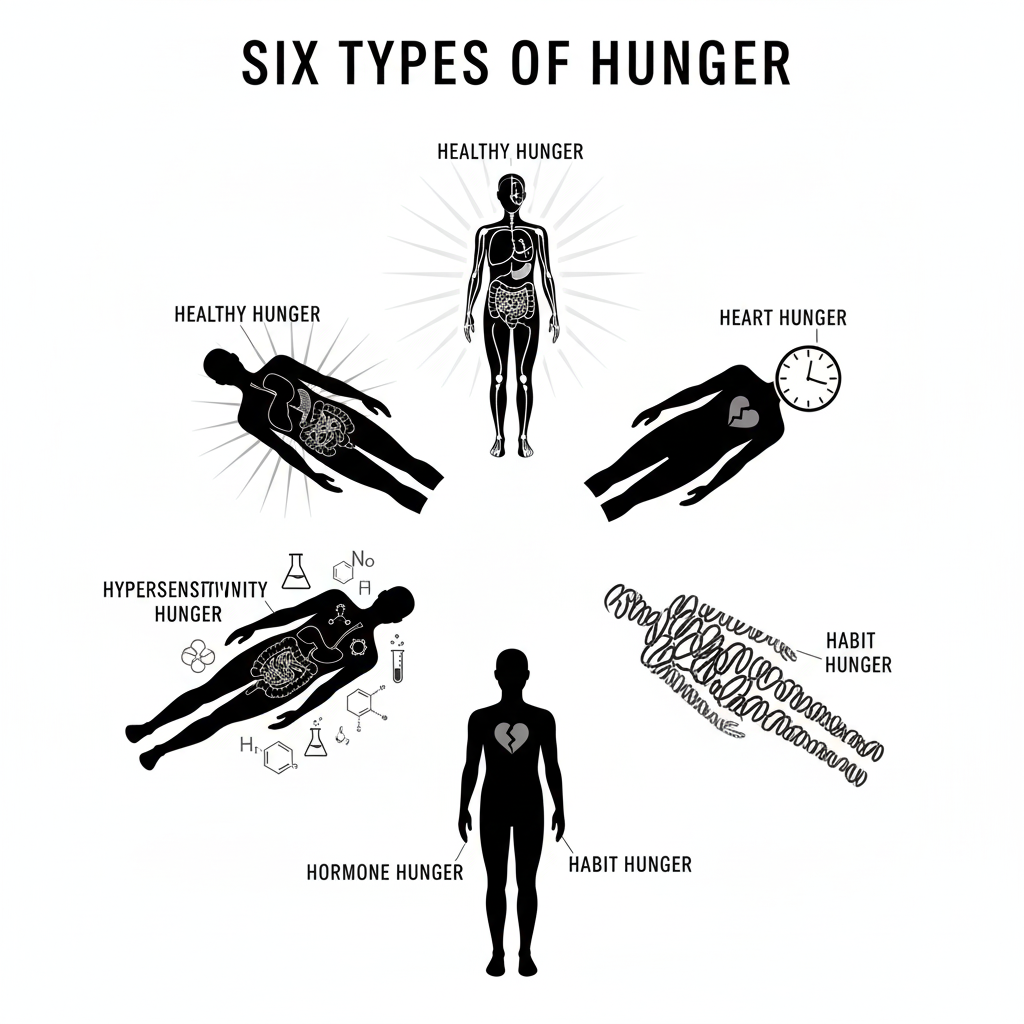
The Six Hungers
So, the million-dollar question in a billion-dollar weight loss Industry is:
Why do we eat in the first place?
Beyond the obvious need to survive, why else do we eat?
We eat because it brings us pleasure. Tastes, textures, and aromas satisfy our senses. Sharing meals with friends and family reinforces close bonds. To strengthen relationships or deepen connections, we invite people for dinner. We look forward to specific traditional dishes on cultural and religious holidays. We celebrate with food, and we soothe with food. In times of disappointment, grief or stress, we may eat for comfort. When we’re bored, eating passes for entertainment. We eat mindlessly out of habit, or when the clock says we should.
All these examples have two things in common. First, none of them involve a biological need for energy or fuel. And second, each starts with a thought. A thought that our brains quickly interpret as hunger.
Healthy Vs Unhealthy Hunger
Hunger is the underlying force that drives us towards food. The dictionary definition of hunger is “a craving or urgent need for food or a specific nutrient.”
I call that Healthy Hunger. Healthy Hunger signifies a physiological need to refuel. It’s accompanied by physical sensations such as a growling stomach, hunger pangs, low energy, dizziness, shakiness or irritability.
Some of those “urgent needs for food” don’t arrive in the form of physical sensations. Instead, these cravings are triggered by something other than the physiological need for food. For example, you might feel like you need popcorn when you watch a movie, a beer while you’re at the hockey game, a hot dog and pretzel at the baseball game, or a pint of ice cream when you’ve had a bad day at work. They’re wants, but the urge is so strong that they feel like needs.
The truth is that hunger – the urgent need for food – is complex. A wide array of circumstances can trigger an urgent need for food. If we lack self-awareness, we categorize them all as true hunger. I’d argue that many people who struggle with their weight are not eating because they are physiologically hungry. They’re eating for emotional comfort, to fit in socially, out of habit, out of association, out of boredom, out of fear of being hungry, due to hormonal imbalances and poor gut function, or a myriad of other reasons that have nothing to do with physiological hunger.
I believe that people who are overweight eat in response to unhealthy hunger more often than healthy hunger. Not necessarily by choice, but because they’ve been conditioned in some sense throughout their life.
In this book, I have categorized 6 Hungers. 6 distinct reasons why we eat. What drives us towards food, and what fundamental underlying forces are at play when we eat. Once we can identify the reasons why we turn to food, we are better able to break free from the hold they have over us.
Six distinct types of Hunger
- Healthy Hunger: True Hunger.
A physiological need for food to fuel bodily processes and activity.
‘Unhealthy Hungers’ - Head Hunger: The scheduled eater.
Eating on a schedule, watching the clock and following rigid rules. - Heart Hunger: The emotional eater.
Eating triggered by emotions or stress. - Habit Hunger: The associative eater.
Associating food with an activity, or eating out of boredom. - Hormone Hunger: Eating due to underlying hormone imbalances or inability to lose weight for similar reasons.
- Hypersensitivity Hunger: Eating or gaining weight due to an unhealthy gut microbiome or food sensitivity.
People who are mentally and physically aligned with healthy hunger cues, are better able to maintain a healthy weight. Those who listen to their body and eat according to healthy hunger cues, are deeply connected to what their body is asking of them.
People who eat in response to unhealthy hunger cues have a harder time maintaining their weight, and may have an unhealthy relationship with food. If you struggle with maintaining a healthy weight when not on a restrictive diet, I believe it’s because you’re misunderstanding your hunger cues. Being disconnected from your body, may lead you to eat out of one, two, maybe three or all of the unhealthy hungers. Learn to tell the difference between Healthy and Unhealthy hunger, and you are on your way to breaking the code to weight loss.